
Tea is a magical calming elixir — like, as if coffee had a therapist.
emotions
Inside the lines, outside the box
Journal: fitting your heart and soul into ruled lines.
Fluctuations
The world constantly sways me between poet and malcontent.
Cry it out
When you allow the tears to flow out, you’re allowing relief and hope and faith and all sorts of good things to come in.
Long ago now
I am searching for my feelings
through shelves of dusty books
can’t help but feel I’ve left them
in some forgotten ancient nooks
as if an author long before me
captured my emotions in his day
and saved them in fine poetry
for future me to find someway
Weekly feels
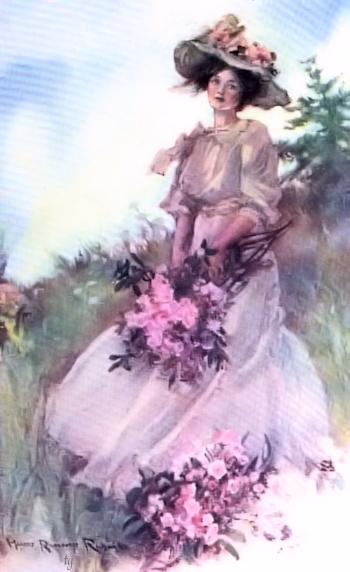
Saturday:
Sunday:
Monday:

Tuesday:

Wednesday:

Thursday:
Friday:
Images in the public domain, modified t.g.
• Saturday — Zandrie by Marian Edwards Richards, 1909, illustration by Harriet Roosevelt Richards, published by The Century Co., contributed by New York Public Library, digitized by Google Books, books.google.com
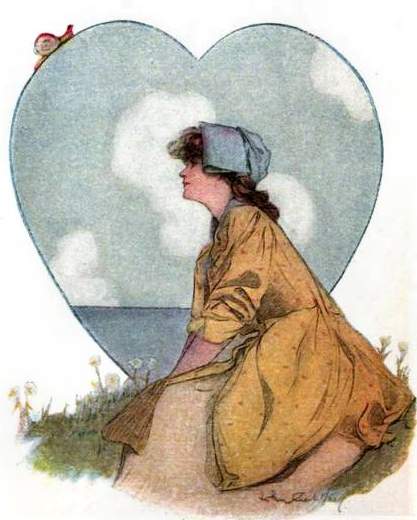
• Sunday — Happy Days by Oliver Herford, 1917, illustrated by John Cecil Clay, published by Mitchell Kennerley, Internet Archive, contributed by University of California Libraries, digitizing sponsor Microsoft, archive.org
• Monday — Wellcome Collection. ‘A young woman of Vienna who died of cholera, depicted four hours before death.’ Coloured stipple engraving, c.1831. wellcomecollection.org
• Tuesday — Happy Days by Oliver Herford, 1917, illustrated by John Cecil Clay, published by Mitchell Kennerley, Internet Archive, contributed by University of California Libraries, digitizing sponsor Microsoft, archive.org
• Wednesday — I got this from an old book years ago but haven’t yet been able to find my notes with the source; oops.
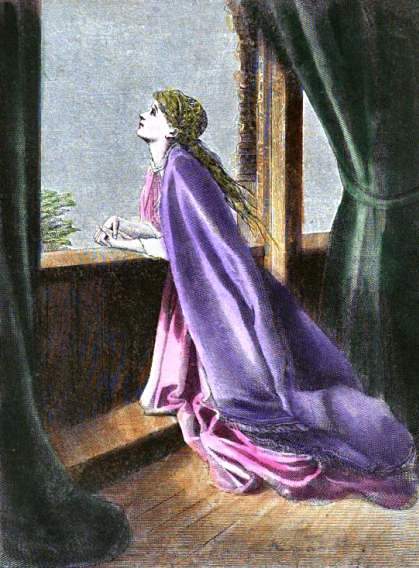
• Thursday — Woman in Sacred Song, compiled and edited by Eva Munson Smith, 1888 edition, published by Arthur E. Whitney, digitized by Google Books, books.google.com
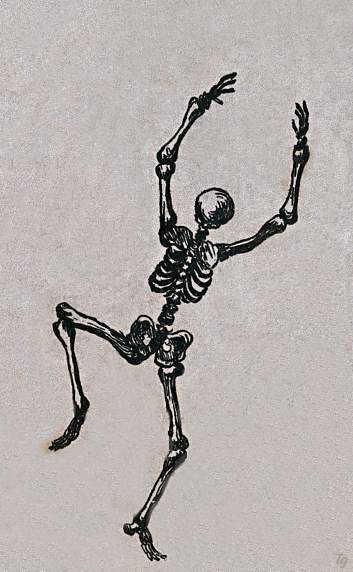
• Friday — Wellcome Collection. ‘Skeletons dancing.’ Etching by R. Stamper after Christopher Sharp. 1700s. wellcomecollection.org
XXXI
My stiff-spread arms
Break into sudden gesture;
My feet seize upon the rhythm;
My hands drag it upwards:
Thus I create the dance.
I drink of the red bowl of the sunlight:
I swim through seas of rain:
I dig my toes into earth:
I taste the smack of the wind:
I am myself:
I live.
The temples of the gods are forgotten or in ruins:
Professors are still arguing about the past and the future:
I am sick of reading marginal notes on life,
I am weary of following false banners:
I desire nothing more intensely or completely than this present;
There is nothing about me you are more likely to notice than my being:
Let me therefore rejoice silently,
A golden butterfly glancing against an unflecked wall.
—John Gould Fletcher (1886–1950), “XXXI,” Irradiations, 1915
Stitches & seams
I need to get over the hard times of my past. They’ve left scars, but scars are just memories.
A curious glimmering thing
“Time has proved that the function of poetry is not to impart messages, but to explore the depths of emotion.
“The poet is never a teacher, but always a learner. His poem is a venture at perilous discovery. The fact of writing is not the recording of something already known to the poet; it is his method of bringing to the light things that were previously in darkness for him.
“The aim of poetry is to capture those rare moments of the poet’s experience when, for good or for evil, the consciousness of life sweeps through him like a flame… the moments when he becomes passionately aware of the crises of his spirit’s secret drama, and sees a pattern taking shape in the void, and words of utterance come singing to his lips.
“Out of that dizzy instant he emerges, bewildered but excitedly hopeful, bringing with him his poem. Here, he says, is a curious glimmering thing that I discovered far down in the sea of my dimly conscious spirit: perhaps it will have a fascination for you, too; perhaps you, too, will see in its pale sphere some hint of the iridescent lights that played on its surface when in those vast deeps I found it.”
—Arthur Davison Ficke (1883–1945), “The Nature of Poetry,” 1926
Umber
there are only so many poems one can write
about umber tree roots and the glowing moon
before the psyche starts crying out to be heard
the suffering of the world isn’t poetic
but it is essential to poetry
Fading in
i am naked and spinning
unmasked and repenting
wasn’t i just fourteen
mere unwound hours ago
i breathed, i sang
a lyric or two, loudly
in my quiet voice —
cycled through colors
found beautiful hues
my butterfly wings
cripplingly morphed
to chrysalis again
— reflect retread —
growing wisdom in my head
thrust out the blonde hair
and that all the new
is gray matters not —
focus is a summit reached
rock bottom at the top
perimenopausal paradox —
if someone would listen
if anyone would care
from up here or down there
the invisible i have become
could unhide everted —
but what has burned out
is not the heart soul
bones mind or gut but
only the brittle shell
of youth — falling apart
shedding and crumbling
finally wasting far away
leaving a glowing
blossom unsplayed —
Fixate
lobotomy by sparrow beak
brain pecked full of dread
brimful society syrupy sweet
carelessness killing us dead
memoryvines creeping through
sockets of wasteland dreams
a humming vibration of stasis
stuck lid on boiling progress
jammed gears of regression—
a spinning orbiting rotation
would be movement at least
incessant click click click
of the going nowhere echoes
like fading robotic heartbeats
a constant why? why? why?
the most important question
that never even mattered
answerless, unanswerable
speedbumps of psychological
queries emerging like stones
in the body — stuck motion
mind eternally trying, failing
to write its story, click clack
bones, ligaments, thoughts
stutter sputter twitch to death
choking on ink overflowing
poems destined for somewhere
turned inward flooding nowhere
release my brain to infancy
for it is smothered with age
Ten thousand fathoms deep
“You peer into my life to find a lingering past, but I tell you it was sunk ten thousand fathoms deep and weighted down with my dead self. You look into my breast to find that old, old open wound, but I tell you I seared it with my hot tears and only the cicatrix is there.”
—Muriel Strode (1875–1964), My Little Book of Prayer, 1904