A Teeny-Tiny Ghost Story

My parents used to read this story to my brothers and me when we were in grade school — after dark, in scary voices. I loved it! The book set that the story is in eventually ended up in their attic for many years, but today we came across it while cleaning and those cherished childhood memories have now come to live on my bookshelves. —tg


“TEENY-TINY”

Reprinted from James Orchard Halliwell, Esq., “Fireside Nursery Stories,” Popular Rhymes and Nursery Tales: A Sequel to the Nursery Rhymes of England, 1849.

This simple tale seldom fails to rivet the attention of children, especially if well told. The last two words should be said loudly with a start. It was obtained from oral tradition, and has not, I believe, been printed. –JOH, Brixton Hill, Surrey, April 1849

Once upon a time there was a teeny-tiny woman lived in a teeny-tiny house in a teeny-tiny village. Now, one day this teeny-tiny woman put on her teeny-tiny bonnet, and went out of her teeny-tiny house to take a teeny-tiny walk. And when this teeny-tiny woman had gone a teeny-tiny way, she came to a teeny-tiny gate; so the teeny-tiny woman opened the teeny-tiny gate, and went into a teeny-tiny churchyard. And when this teeny-tiny woman had got into the teeny-tiny churchyard, she saw a teeny-tiny bone on a teeny-tiny grave, and the teeny-tiny woman said to her teeny-tiny self, “This teeny-tiny bone will make me some teeny-tiny soup for my teeny-tiny supper.” So the teeny-tiny woman put the teeny-tiny bone into her teeny-tiny pocket, and went home to her teeny-tiny house.

Now when the teeny-tiny woman got home to her teeny-tiny house, she was a teeny-tiny tired; so she went up her teeny-tiny stairs to her teeny-tiny bed, and put the teeny-tiny bone into a teeny-tiny cupboard. And when this teeny-tiny woman had been to sleep a teeny-tiny time, she was awakened by a teeny-tiny voice from the teeny-tiny cupboard, which said, “Give me my bone!” And this teeny-tiny woman was a teeny-tiny frightened, so she hid her teeny-tiny head under the teeny-tiny clothes, and went to sleep again. And when she had been to sleep again a teeny-tiny time, the teeny-tiny voice again cried out from the teeny-tiny cupboard a teeny-tiny louder, “Give me my bone!” This made the teeny-tiny woman a teeny-tiny more frightened, so she hid her teeny-tiny head a teeny-tiny further under the teeny-tiny clothes. And when the teeny-tiny woman had been to sleep again a teeny-tiny time, the teeny-tiny voice from the teeny-tiny cupboard said again a teeny-tiny louder, “Give me my bone!” And this teeny-tiny woman was a teeny-tiny bit more frightened, but she put her teeny-tiny head out of the teeny-tiny clothes, and said in her loudest teeny-tiny voice, “TAKE  IT!”

No Kings quotes

*  *  *

How happy we ought to be that we have no kings in America!

J. Smytthe, Jr, 1853

*  *  *

      It was the birthday of the Neapolitan King. According to custom, the various vessels in the harbor of Naples were decked in their gayest colors, while the men-of-war fired salutes at sunrise, noon, and sunset. However, this year there was an exception — the vessel of Commodore Morgan, U.S.N., which had recently arrived to the harbor.
      The King sent for the Commodore. “Commodore Morgan, I wish to know if your nation desired that you show to me the disrespect which I observed?”
      “May I ask your Majesty,” said the Commodore, “how I have been wanting in respect towards your Majesty?”
      “It is my birthday, and, of all the vessels in port, yours alone did not deign to fire salutes.”
      “Ah, sir!” replied Morgan, “pardon my republican manners. We have no kings in America, and it is not the custom to fire salutes upon our President’s birthday.”

—The Anecdote of Commodore Morgan, 1853

*  *  *

America has no king, that is it has no officer to whom wealth and from whom corruption flow. It has no hereditary oligarchy, that is it acknowledges no order of men privileged to cheat and insult the rest of the members of the State.

—Percy Bysshe Shelley, 1820

*  *  *

America has no king, whose whim could be made into a law.

—Jay William Hudson, 1922

*  *  *

The extraordinary notion that the President has exclusive control over the use of the army has been in part produced by a vague impression of resemblance between his constitutional prerogative and that of sovereigns under constitutional governments. This impression is begotten partly of pride, partly of fear, and greatly of ignorance. There are some people who take such pride in everything American that they must needs consider their own chief magistrate as mightier than a king. It is not an uncommon thing to hear one of these foolish persons boast that their President has more power than the Queen of England, nay, that he is the greatest magistrate in the world. A false analogy here ministers to pride. Because the President is chief magistrate it is inferred that he is like other chief magistrates, and as these are in general kings, it does not require a great stretch of the imagination to fancy that he also is a sort of king. But an American President is not a king, nor anything like a king, any more than he is like the Emperor of Russia, the Sultan of Turkey, or the Mikado of Japan. The chief magistracy is not of necessity a kingly office. The Governors of our States are chief magistrates also, but they are not little kings.

—David Dudley Field, 1877

*  *  *

I have a short answer to all this. America has no king!

—Dublin University Magazine, 1834

*  *  *

The King who comes to his office by virtue of birth, and not of personal qualifications, reigns but does not govern. The republican magistrate does not reign; but it is implied in his position that, within the limits of authority which the law gives him, he should govern. This is implied in the very notion of an elected magistrate. If he is not chosen on account of his capacity for government, why should he be chosen at all?

—The Saturday Review, 1877

*  *  *

It Should be considered, that there are in America, no Kings, Princes, or Nobles: no Popes, Cardinals, Patriarchs, Archbishops, Bishops, or other ecclesiastical Dignitaries. All publick offices and Employments are bestowed, by the free Choice of the People.

—John Adams, 1780

*  *  *

The U.S. Constitution was designed to prevent and control berserk actions by a President and by the Executive Branch of government. Presidents are not kings; they have no Divine Right; and when they commit actions that are immoral, or in violation of the Constitution, they must be stopped, or this country will cease to function as a free Constitutional democracy.

—Pete Hamill, 1972

*  *  *

Every great movement on behalf of humanity leads to organized action. The modern world is learning the enormous value of intelligent and free cooperation; for it is a triumph of the democratic spirit. The people today resolve to do things for themselves. In order to do them, they must combine their energies and their wits, utilize the peculiar power of each individual, and march side by side to the accomplishment of results. Party is simply cooperation. It is not servitude, if the rank and file have brains; for so-called leaders are only servants, if they do but execute the will, and carry out the thought of the people. Presidents are not kings, though entrusted with far more power than most kings possess. There is even no honor in their election, except on the admission that it is an honor to be permitted to serve. The moment a leader sets up to be master instead of servant, let him be promptly dismissed.

—Francis Ellingwood Abbot, 1870

*  *  *

Here is an attempt to throw something of the mystery of kingship round one who is not a King and who cannot really act as a King. A President chosen for four years cannot really play a King’s part. There is nothing sacred about him. He must submit to praise and blame.

—The Saturday Review, 1877

*  *  *

The American system is strictly republican. The relations between President and Congress, whatever may be their advantages and disadvantages, follow naturally from the decision of the founders of the Constitution that the executive power should be vested in a single man and not in a council, and that that single man should be, not a king, but a magistrate: elective, terminable, and responsible.

—Edward A. Freeman, 1879

*  *  *

      We told him we lived in America beneath the flag for which our fathers fought; that we lived in the United States, and we had a right and had a ground to fight on; and we asked the governor to abolish the Baldwin guards. That was the chief thing I was after because I knew when we cleaned them out other things would come with it.
      I called the committee, and I said, “Here, take this document into the governor’s office and present it to him. Now, don’t get on your knees; you don’t need to get on your knees; we have no kings in America; stand on both feet, with your heads erect.”

—Mother Jones, 1912

*  *  *

In America, our president will not only be without the influencing advantages of the British king, but they will be in the possession of the people at large, to strengthen their hands in the event of a contest with him. In short, danger from ecclesiastical tyranny, that long standing and still remaining curse of the people — that sacrilegious engine of royal power in some countries — can be feared by no man in the United States.

—Tench Coxe, 1788

*  *  *

The position of the President of the United States one peculiarly well fitted for learning the truth in regard to a political question! Why, sir, palaces are not proverbial for the amount of truth that is uttered in the ears of the king. Indeed, it is probably one of the most repulsive features that surround a man having the kingly office, that from the day of his birth to the day of his death he never hears the honest, simple truth spoken. The President of the United States, it is true, is not a king; but some of the incidents attaching to kings attach to him, and one of those incidents is that he is less likely than almost any other man in the nation to hear the truth spoken. Who are the men that surround him, and what are their purposes and objects? To speak the truth? Oh no, sir. They are men having other purposes and other objects than to tell the truth. They have an eye to fat contracts, to gifts, and emoluments. They do not go there to offend the ear of majesty by speaking the truth, unless it should be pleasant to the ear of majesty to hear it. About the courts of kings, and, I fear, about presidential mansions, there are many who may, without impropriety, be styled toads, who live upon the vapor of the palace. They may have the precious jewel of truth in their heads, but they are specially cautious not to have it on their tongues.

—Lafayette S. Foster, 1858

*  *  *

NOTE:  Some of these quotations have been edited for clarity and brevity. For the full excerpts and attributions, plus several more “no kings” quotes, please see www.quotegarden.com/no-kings.html

Confessions of a Worrier

“If any man or woman knows more about worrying than I do, that man or woman is sincerely to be pitied. To begin with, I come of honorable generations of worriers, all of whom seemed to be deeply sensible of their responsibility for the carrying on of a world which they did not create. My grandfather used to worry about the weather and crops. My mother worried with an elaboration and finish which really lent distinction to her performance. She could worry harder and longer on less provocation than anybody else I ever knew. When it became my turn to take up the burden of the universe I was quite as successful as she.

“As a child, I worried about the end of the world, and the Unpardonable Sin, which I knew I had committed, if I could only find out what it was. I worried my way through school and into college, where my course in worry was so complete that I came out with nervous prostration and two deep furrows between my eyebrows which I shall wear, like the scars of battle they really are, to my dying day. And then I worried about the furrows!

“I began to see the light through reading Menticulture by Horace Fletcher which put a vague old Buddhist doctrine into a modern, concrete formula — ‘Anger and worry are bad habits of the mind. They are not necessary ingredients.’ Worry not necessary! I had always supposed it was as much my business to worry as it was to breathe, and I looked upon people who did not worry as the shirks and cowards of creation, who were easy in their minds simply because they were criminally indifferent to their duties.”

—Mary Boardman Page, “The Confessions of a Worrier,” 1899, a little altered

Weekly feels

Saturday:

Sunday:

Monday:

Tuesday:

Wednesday:

Thursday:

Friday:


Images in the public domain, modified t.g.
• Saturday — Zandrie by Marian Edwards Richards, 1909, illustration by Harriet Roosevelt Richards, published by The Century Co., contributed by New York Public Library, digitized by Google Books, books.google.com
• Sunday — Happy Days by Oliver Herford, 1917, illustrated by John Cecil Clay, published by Mitchell Kennerley, Internet Archive, contributed by University of California Libraries, digitizing sponsor Microsoft, archive.org
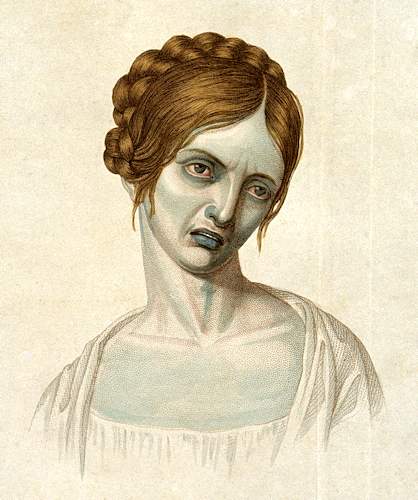
• Monday — Wellcome Collection. ‘A young woman of Vienna who died of cholera, depicted four hours before death.’ Coloured stipple engraving, c.1831. wellcomecollection.org
• Tuesday — Happy Days by Oliver Herford, 1917, illustrated by John Cecil Clay, published by Mitchell Kennerley, Internet Archive, contributed by University of California Libraries, digitizing sponsor Microsoft, archive.org
• Wednesday — I got this from an old book years ago but haven’t yet been able to find my notes with the source; oops.
• Thursday — Woman in Sacred Song, compiled and edited by Eva Munson Smith, 1888 edition, published by Arthur E. Whitney, digitized by Google Books, books.google.com
• Friday — Wellcome Collection. ‘Skeletons dancing.’ Etching by R. Stamper after Christopher Sharp. 1700s. wellcomecollection.org


Shut—your—mouth

“Having devoted the greater part of my life to visiting and studying the various Native Races of North and South America, and observing the healthy condition and physical perfection of those peoples in their primitive state, I believe I have discovered the cause of numerous health problems that exist in our civilized communities. I believe, and feel authorized to assert, that a great proportion of the diseases prematurely fatal to human life, as well as mental and physical deformities, and destruction of the teeth, are caused by abuse of the lungs, in the Mal-respiration of Sleep.

“Quiet and natural sleep is the great physician and restorer of mankind; but the habit of sleeping with the mouth open is destructive to the human constitution. Man’s cares and fatigues of the day become a daily disease, for which quiet sleep is the cure; and the All-wise Creator has so constructed him that his breathing lungs support him through that sleep, like a perfect machine, regulating the digestion of the stomach and the circulation of the blood, and carrying repose and rest to the utmost extremity of every limb; and for the protection and healthy working of this machine through the hours of repose, He has formed him with nostrils intended for measuring and tempering the air that feeds this moving principle and fountain of life; and as the quieting and restoring influence of the lungs in natural repose is carried to every limb and every organ, so in unnatural and abused repose, do they send their complaints to the extremities of the system, in various diseases; and under continued abuse, fall to pieces themselves.

“There is no animal in nature, excepting Man, that sleeps with the mouth open; and with mankind, I believe the habit, which is not natural, is generally confined to civilized communities, where he is nurtured and raised amidst enervating luxuries and unnatural warmth, where the habit is easily contracted, and in sudden changes of temperature, even in his own house. Through the enjoyment of his artificial comforts and pleasures, he is destroying his teeth, his good looks, and often his life, in the thoughtless departure from natural simplicities and instincts. Man, who suffers under many ills in life, should take care that his lungs and teeth, however much abused during the day, should at least be treated with kindness during the night. Breathing should be done as Nature designed it, through the nose.

“There is no perfect sleep for man or brute, with the mouth open. When you close your eyes to sleep, close your mouth too, only to be opened after your eyes and ears in the morning. Though the majority of civilized people are more or less addicted to the habit of sleeping with the mouth open, few will admit that they are subject to it. They go to sleep and awake, with their mouths shut, not knowing that the insidious enemy, like the deadly Vampire that imperceptibly sucks the blood, gently steals upon them in their sleep and does its work of death whilst they are unconscious of the evil. Every physician should advise his patients, and every school its pupils, and every hospital, regiment, nursery, and mother should attempt to stop this unnatural and dangerous habit.

“If I were to endeavour to bequeath to posterity the most important Motto which human language can convey, it should be in three words:  Shut—your—mouth.”

—George Catlin, The Breath of Life and Shut Your Mouth, 1860s, abridged

Leaden Echo & Golden Echo

THE LEADEN ECHO

How to kéep—is there ány any, is there none such, nowhere known some, bow or brooch or braid or brace, láce, latch or catch or key to keep

Back beauty, keep it, beauty, beauty, beauty,… from vanishing away?

Ó is there no frowning of these wrinkles, rankèd wrinkles deep,

Dówn? no waving off of these most mournful messengers, still messengers, sad and stealing messengers of grey?

No there ’s none, there ’s none, O no there ’s none,

Nor can you long be, what you now are, called fair,

Do what you may do, what, do what you may,

And wisdom is early to despair:

Be beginning; since, no, nothing can be done

To keep at bay

Age and age’s evils, hoar hair,

Ruck and wrinkle, drooping, dying, death’s worst, winding sheets, tombs and worms and tumbling to decay;

So be beginning, be beginning to despair.

O there ’s none; no no no there ’s none:

Be beginning to despair, to despair,

Despair, despair, despair, despair.

THE GOLDEN ECHO

         Spare!

There ís one, yes I have one (Hush there!);

Only not within seeing of the sun,

Not within the singeing of the strong sun,

Tall sun’s tingeing, or treacherous the tainting of the earth’s air,

Somewhere elsewhere there is ah well where! one,

One. Yes I can tell such a key, I do know such a place,

Where whatever ’s prized and passes of us, everything that ’s fresh and fast flying of us, seems to us sweet of us and swiftly away with, done away with, undone,

Undone, done with, soon done with, and yet dearly and dangerously sweet

Of us, the wimpled-water-dimpled, not-by-morning-matchèd face,

The flower of beauty, fleece of beauty, too too apt to, ah! to fleet,

Never fleets móre, fastened with the tenderest truth

To its own best being and its loveliness of youth: it is an everlastingness of, O it is an all youth!

Come then, your ways and airs and looks, locks, maiden gear, gallantry and gaiety and grace,

Winning ways, airs innocent, maiden manners, sweet looks, loose locks, long locks, lovelocks, gaygear, going gallant, girlgrace—

Resign them, sign them, seal them, send them, motion them with breath,

And with sighs soaring, soaring síghs deliver

Them; beauty-in-the-ghost, deliver it, early now, long before death

Give beauty back, beauty, beauty, beauty, back to God, beauty’s self and beauty’s giver.

See; not a hair is, not an eyelash, not the least lash lost; every hair

Is, hair of the head, numbered.

Nay, what we had lighthanded left in surly the mere mould

Will have waked and have waxed and have walked with the wind what while we slept,

This side, that side hurling a heavyheaded hundredfold

What while we, while we slumbered.

O then, weary then whý should we tread? O why are we so haggard at the heart, so care-coiled, care-killed, so fagged, so fashed, so cogged, so cumbered,

When the thing we freely fórfeit is kept with fonder a care,

Fonder a care kept than we could have kept it, kept

Far with fonder a care (and we, we should have lost it) finer, fonder

A care kept.—Where kept? Do but tell us where kept, where.—

Yonder.—What high as that! We follow, now we follow.—Yonder, yes, yonder, yonder,

Yonder.

—Gerard Manley Hopkins (1844–1889), “The Leaden Echo and the Golden Echo,” maidens’ song from the unfinished tragedy St. Winefred’s Well, in Poems of Gerard Manley Hopkins, now first published, edited and with notes by Robert Bridges, 1918

An Artist’s Sorrows

As the nightingale went home in the morning and hung his golden harp on the peg, he said in a bitter tone — ’Let them be sure of this, I will not sing again.’

And his wife came up to him with chirpings and hoppings to soothe him:  but nothing availed; it was clear to all that he was bitterly affronted.

Every night he went out and sang his loves to the rose; the night air throbbed and quivered to the sound.

His wife sat at home, and was contented if he was happy; moreover, she thought that, however his love raged, no harm could possibly come of it.

And now at her entreaty he told her of his sorrows, and how deeply he was wounded by what had passed.

‘I sang sweetly! I sang sweetly! the rose opened her leaves; it seemed to me that the moon rose earlier than her wont.

‘All things listened — all things near and far off listened, save only the youth and maiden who were close to me.

‘I sang sweetly! I sang sweetly! but they only turned and whispered to each other…’

—V. A. R., “An Artist’s Sorrows,” from the Kamschatskan, Poems, 1867

So tired!

“I have been awfully busy… And it tires me so that generally I go to bed again the next minute after I get up:  and sometimes I go to bed again a minute beforeI get up!  Did you ever hear of any one being so tired as that ?

—Lewis Carroll, 1879