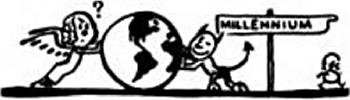
—LIFE magazine, 1922

—LIFE magazine, 1922
I who have loved the sound of leaves
Restlessly writhing into speech
Desire that to my silent grave
Only leaves shall reach.
So I who walked above the ground,
And leaves that danced before the sun
May meet below to form one dust
And in the earth be one.
When the last wind has stripped the boughs
Some autumn, go out anywhere
To any tree, and look beneath
The leaves: I may be there.
—Paul Engle, “Leaves for the Dead,” 1929
Trickling down from branch to branch
Like a saffron avalanche,
Filtering through the sylvan gauze
As a frozen topaz thaws,
Lay, in puddles on the moss,
Golden solar, apple-sauce…
—Tom Prideaux (1908–1993), “The Sun-Shunner,” written in the
While researching an old quotation in Google Books, I came across this LIFE “Liars’ Number” magazine cover from 101 years ago, captioned “Getting away

LIFE: Liars’ Number, 1922
* * *
How happy we ought to be that we have no kings in America!
—
* * *
It was the birthday of the Neapolitan King. According to custom, the various vessels in the harbor of Naples were decked in their gayest colors, while the men-of-war fired salutes at sunrise, noon, and sunset. However, this year there was an exception — the vessel of Commodore Morgan, U.S.N., which had recently arrived to the harbor.
The King sent for the Commodore. “Commodore Morgan, I wish to know if your nation desired that you show to me the disrespect which I observed?”
“May I ask your Majesty,” said the Commodore, “how I have been wanting in respect towards your Majesty?”
“It is my birthday, and, of all the vessels in port, yours alone did not deign to fire salutes.”
“Ah, sir!” replied Morgan, “pardon my republican manners. We have no kings in America, and it is not the custom to fire salutes upon our President’s birthday.”
—The Anecdote of Commodore Morgan, 1853
* * *
America has no king, that is it has no officer to whom wealth and from whom corruption flow. It has no hereditary oligarchy, that is it acknowledges no order of men privileged to cheat and insult the rest of the members of the State.
—Percy Bysshe Shelley, 1820
* * *
America has no king, whose whim could be made into a law.
—Jay William Hudson, 1922
* * *
The extraordinary notion that the President has exclusive control over the use of the army has been in part produced by a vague impression of resemblance between his constitutional prerogative and that of sovereigns under constitutional governments. This impression is begotten partly of pride, partly of fear, and greatly of ignorance. There are some people who take such pride in everything American that they must needs consider their own chief magistrate as mightier than a king. It is not an uncommon thing to hear one of these foolish persons boast that their President has more power than the Queen of England, nay, that he is the greatest magistrate in the world. A false analogy here ministers to pride. Because the President is chief magistrate it is inferred that he is like other chief magistrates, and as these are in general kings, it does not require a great stretch of the imagination to fancy that he also is a sort of king. But an American President is not a king, nor anything like a king, any more than he is like the Emperor of Russia, the Sultan of Turkey, or the Mikado of Japan. The chief magistracy is not of necessity a kingly office. The Governors of our States are chief magistrates also, but they are not little kings.
—David Dudley Field, 1877
* * *
I have a short answer to all this.
—Dublin University Magazine, 1834
* * *
The King who comes to his office by virtue of birth, and not of personal qualifications, reigns but does not govern. The republican magistrate does not reign; but it is implied in his position that, within the limits of authority which the law gives him, he should govern. This is implied in the very notion of an elected magistrate. If he is not chosen on account of his capacity for government, why should he be chosen at all?
—The Saturday Review, 1877
* * *
It Should be considered, that there are in America, no Kings, Princes, or Nobles: no Popes, Cardinals, Patriarchs, Archbishops, Bishops, or other ecclesiastical Dignitaries. All publick offices and Employments are bestowed, by the free Choice of the People.
—John Adams, 1780
* * *
The U.S. Constitution was designed to prevent and control berserk actions by a President and by the Executive Branch of government. Presidents are not kings; they have no Divine Right; and when they commit actions that are immoral, or in violation of the Constitution, they must be stopped, or this country will cease to function as a free Constitutional democracy.
—Pete Hamill, 1972
* * *
Every great movement on behalf of humanity leads to organized action. The modern world is learning the enormous value of intelligent and free cooperation; for it is a triumph of the democratic spirit. The people today resolve to do things for themselves. In order to do them, they must combine their energies and their wits, utilize the peculiar power of each individual, and march side by side to the accomplishment of results. Party is simply cooperation. It is not servitude, if the rank and file have brains; for
—Francis Ellingwood Abbot, 1870
* * *
Here is an attempt to throw something of the mystery of kingship round one who is not a King and who cannot really act as a King. A President chosen for four years cannot really play a King’s part. There is nothing sacred about him. He must submit to praise and blame.
—The Saturday Review, 1877
* * *
The American system is strictly republican. The relations between President and Congress, whatever may be their advantages and disadvantages, follow naturally from the decision of the founders of the Constitution that the executive power should be vested in a single man and not in a council, and that that single man should be, not a king, but a magistrate: elective, terminable, and responsible.
—Edward A. Freeman, 1879
* * *
We told him we lived in America beneath the flag for which our fathers fought; that we lived in the United States, and we had a right and had a ground to fight on; and we asked the governor to abolish the Baldwin guards. That was the chief thing I was after because I knew when we cleaned them out other things would come with it.
I called the committee, and I said, “Here, take this document into the governor’s office and present it to him. Now, don’t get on your knees; you don’t need to get on your knees; we have no kings in America; stand on both feet, with your heads erect.”
—Mother Jones, 1912
* * *
In America, our president will not only be without the influencing advantages of the British king, but they will be in the possession of the people at large, to strengthen their hands in the event of a contest with him. In short, danger from ecclesiastical tyranny, that long standing and still remaining curse of the people — that sacrilegious engine of royal power in some countries — can be feared by no man in the United States.
—Tench Coxe, 1788
* * *
The position of the President of the United States one peculiarly well fitted for learning the truth in regard to a political question! Why, sir, palaces are not proverbial for the amount of truth that is uttered in the ears of the king. Indeed, it is probably one of the most repulsive features that surround a man having the kingly office, that from the day of his birth to the day of his death he never hears the honest, simple truth spoken. The President of the United States, it is true, is not a king; but some of the incidents attaching to kings attach to him, and one of those incidents is that he is less likely than almost any other man in the nation to hear the truth spoken. Who are the men that surround him, and what are their purposes and objects? To speak the truth? Oh no, sir. They are men having other purposes and other objects than to tell the truth. They have an eye to fat contracts, to gifts, and emoluments. They do not go there to offend the ear of majesty by speaking the truth, unless it should be pleasant to the ear of majesty to hear it. About the courts of kings, and, I fear, about presidential mansions, there are many who may, without impropriety, be styled toads, who live upon the vapor of the palace. They may have the precious jewel of truth in their heads, but they are specially cautious not to have it on their tongues.
—Lafayette S. Foster, 1858
* * *
NOTE: Some of these quotations have been edited for clarity and brevity. For the full excerpts and attributions, plus several more
“I am middle-aged. Fifty is upon me. And I am faced by a grim reaper. But it is not youth I want. It is time. And there’s too little left. What shall I do about it? Shall I waste these remaining years on people who bore me, squander them on employments that satisfy no desires, sacrifice them to the ideas of others? No. I have wasted hours upon hours on nothing but waiting, days upon days on routine that led nowhere, and a tally of weeks on nonsense and
“I had an idea that in middle age somehow I should reach a hill and beyond it would lie a promised land. Enough merely to be climbing up. Suddenly now I realize the crown of that hill is age fifty. And I know that if there is a promised land it has got to be in front of me. If I don’t find it now I never shall. So I had better face this fifty, acknowledge it is gone — whether squandered or treasured — forever, and plan what to do with this promised land, how to spend these last precious years left to me.
“From the brow of that fifty hill, suddenly I am beginning to compute time. Do I wish to spend so much of it in my remaining years on the pursuit of youthful looks, on this cult of youth? Perhaps I am a miser with my years, but I must confess that I can no longer see value received from pursuing youth. It will bring me no higher price for my work. It will make my husband no fonder; for affection after fifty rests on something other than complexion. It will not add to my emotional satisfaction nor to the pleasures of my mind. No, I shall not waste any of my remaining years on the pursuit of smooth pink cheeks. Nor will I waste my time or worry with weight, counting calories, or other such psychological-gastronomic engagements!
“Frankly, I do not feel the same as I did twenty years ago. Moreover, I do not want to feel the same. These new feelings — may they not be an asset instead of a liability? I will not be satisfied if my remaining years are a mere repetition of those that have gone before. I want something different. I will not spend this time in an effort to produce an illusion to myself. I will be content to look my age, to dress my age, to live my age. I will appreciate all that life has brought me. I will face fifty cheerfully.
“Do not take this to mean that I am negating its challenges. Fifty does not mean freedom from family demands nor from the things that we are tied to by duty. Fifty brings no alchemy that enables one to plan one’s life as one might try an uncharted sea. We will always have personal and financial limitations, and we can only alter our course according to the wheel in our hands, the craft under us, the shoals and currents around us. But what we may do is decide which direction to steer and how to get the maximum of enjoyment in the steering.
“I must be economical of time. Each day must count. I must plan for the satisfaction that is possible here, now. In youth, always before us was that will-o’-the-wisp, perfection, because there was always the hope of time to reach it. That it was always to be
“May the acceptance of the truth of fifty bring its own joys. No longer do I need to pretend. I may say things frankly. I can accept myself as middle-aged, and therefore enjoy myself. I can squeeze the utmost out of what I am and what I have. I can relax from the struggle. I shall no longer punish myself. Instead of competing, I can create. I may choose what I like, including the colors that please me — that do something to my brain, if not indeed to my soul — rather than attempting to express the best in taste and fashion. No longer do I need to try to take everything as it comes, but select what I want. And please understand: I am not retiring — I am attaining.”
—Emily Newell Blair (1877–1951), “I Prepare to Face Fifty,” 1926, abridged
“Time has proved that the function of poetry is not to impart messages, but to explore the depths of emotion.
“The poet is never a teacher, but always a learner. His poem is a venture at perilous discovery. The fact of writing is not the recording of something already known to the poet; it is his method of bringing to the light things that were previously in darkness for him.
“The aim of poetry is to capture those rare moments of the poet’s experience when, for good or for evil, the consciousness of life sweeps through him like a flame… the moments when he becomes passionately aware of the crises of his spirit’s secret drama, and sees a pattern taking shape in the void, and words of utterance come singing to his lips.
“Out of that dizzy instant he emerges, bewildered but excitedly hopeful, bringing with him his poem. Here, he says, is a curious glimmering thing that I discovered far down in the sea of my dimly conscious spirit: perhaps it will have a fascination for you, too; perhaps you, too, will see in its pale sphere some hint of the iridescent lights that played on its surface when in those vast deeps I found it.”
—Arthur Davison Ficke (1883–1945), “The Nature of Poetry,” 1926
I searched the history of grass,
Beneath hawk-shadows blowing past.
I learned the timelessness of stone;
Saw forest-flesh and forest-bone
Reach briefly up, go swiftly down,
Crash in green, dissolve to brown.
Taught by decay and schooled by molder,
I can turn a stoic shoulder
To beauty spiking searching eyes
And breasts defenselessly unwise.
Against impermanence I lock
My soul, confiding it to rock.
—Frances M. Frost (1905–1959), “Stoic,” Hemlock Wall, 1929
From my highest hill
I watched for Antares.
Brief would be his glimmer
Where the long line of mountains
Duped the horizon
With vague, rambling mist.
And I shall never know
If that was Antares’
Eye on the earth-line,
Or the gleam of a lantern
The wild poet carried;
For God who saw both
Only laughs when I ask him.
—Olive Tilford Dargan (1869–1968), Lute and Furrow, 1922
You know the Model of your Car.
You know just what its powers are.
You treat it with a deal of care,
Nor tax it more than it will bear.
But as to self — that’s different.
Your mechanism may be bent,
Your carburetor gone to grass,
Your engine just a rusty mass.
Your wheels may wobble and your cogs
Be handed over to the dogs,
And on you skip, and skid, and slide,
Without a thought of things inside.
What fools indeed we mortals are
To lavish care upon a Car,
With ne’er a bit of time to see
About our own machinery!
—John Kendrick Bangs (1862–1922), “Motors,” The Cheery Way: A Bit of Verse For Every Day, 1920
You need not think
It’s vanity that makes me prink,
And take much care
To keep myself both fit and fair.
‘Tis not false pride or vain conceit
That keeps me trying to be neat,
But just the plain and simple truth
That I have held to since my youth
That this old frame in which I dwell
Is nothing more than the hotel
In which my Soul and Hopes must stay
Until I’m called to move away,
And for their dwelling-place I plan
To give them quite the best I can,
And keep the place up spick and span.
—John Kendrick Bangs (1862–1922), “An Explanation,” The Cheery Way: A Bit of Verse For Every Day, 1920
“He didn’t tell me how to live; he lived, and let me watch him do it. Dad never was a money-maker, and, as nearly as I can make out, he never wanted to be. He worked mighty hard when he worked, but his real job was living.”
—Clarence Budington Kelland, 1927
“My father used to play with my brother and me in the yard. Mother would come out and say, ‘You’re tearing up the grass.’ ‘We’re not raising grass,’ Dad would reply. ‘We’re raising boys.’”
—Harmon Killebrew, 1984
If I had a big balloon
Round as any Harvest Moon
And a bully kicked it, say,
With his foot, and ran away.
All the world would comfort me,
Saying softly, “What a shame!”
Well, it wasn’t stamped or kicked,
My balloon was only pricked
With a very little pin
Touched to it, not driven in.
No one came to comfort me
Though ’twas broken, just the same.
—Janet Barton,