“The knowledge of my years is ever with me, a sort of binding torment, like an armhole that is
—Kate Trimble Sharber, At the Age of Eve, 1911

collected from other authors
“The knowledge of my years is ever with me, a sort of binding torment, like an armhole that is
—Kate Trimble Sharber, At the Age of Eve, 1911
Once, long ago, I heard an old man say,
“Two pounds of sorrow is the price you pay
For every pound of bliss.”
But I was young and such a reckoning
Seemed far too steep; now, in a later spring,
I’d gladly offer far, far more than this.
—Alice Mackenzie Swaim, “Now, in a Later Spring,” Crickets Are Crying Autumn, 1960
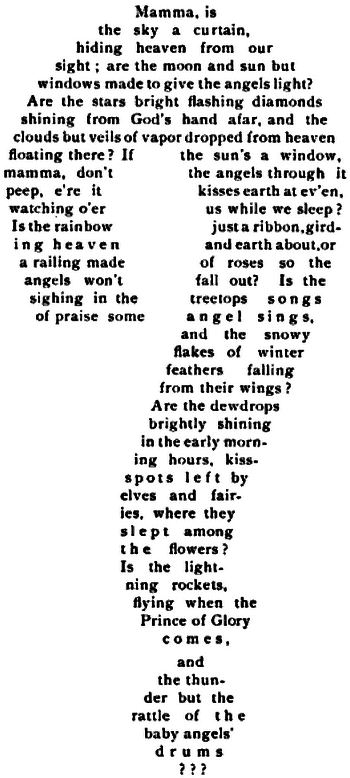
—Anonymous, The Queries Magazine, 1890
“He didn’t tell me how to live; he lived, and let me watch him do it. Dad never was a money-maker, and, as nearly as I can make out, he never wanted to be. He worked mighty hard when he worked, but his real job was living.”
—Clarence Budington Kelland, 1927
“My father used to play with my brother and me in the yard. Mother would come out and say, ‘You’re tearing up the grass.’ ‘We’re not raising grass,’ Dad would reply. ‘We’re raising boys.’”
—Harmon Killebrew, 1984
Strange wares are handled on the wharves of sleep:
Shadows of shadows pass, and many a light
Flashes a signal fire across the night;
Barges depart whose voiceless steersmen keep
Their way without a star upon the deep;
And from lost ships, homing with ghostly crews,
Come cries of incommunicable news,
While cargoes pile the piers, a moon-white
Budgets of dream-dust, merchandise of song,
Wreckage of hope and packs of ancient wrong,
Nepenthes gathered from a secret strand,
Fardels of heartache, burdens of old sins,
Luggage sent down from dim ancestral inns,
And bales of fantasy from No-Man’s Land.
—Edwin Markham, “The Wharf of Dreams,” The Man with the Hoe and Other Poems, 1899
If I had a big balloon
Round as any Harvest Moon
And a bully kicked it, say,
With his foot, and ran away.
All the world would comfort me,
Saying softly, “What a shame!”
Well, it wasn’t stamped or kicked,
My balloon was only pricked
With a very little pin
Touched to it, not driven in.
No one came to comfort me
Though ’twas broken, just the same.
—Janet Barton,
“Now this may sound nonsense, but that is merely because we are fools. There is an eternal vital correspondence between our blood and the sun: there is an eternal vital correspondence between our nerves and
—D. H. Lawrence (1885–1930), Apocalypse, 1931
“What a miserable thing life is: you’re living in clover, only the clover isn’t
—Bertolt Brecht, Jungle of Cities, 1923, translated by
“The life of every man is a diary in which he means to write one story, and writes another; and his humblest hour is when he compares the volume as it is with what he vowed to
—J. M. Barrie, The Little Minister, 1891
“If I tint these pages with too many sunsets, it is not from unawareness of my weakness, but because without them a description of Arizona does not describe. In the afternoon hours, between four and eight, the country wakes and glows, and has its moment, like a woman whose youth was plain but whom middle age has touched with charm and mystery.”
—Winifred Hawkridge Dixon, Westward Hoboes: Ups and Downs of Frontier Motoring, 1921
Nothing begins, and nothing ends,
That is not paid with moan;
For we are born in others’ pain,
And perish in our own.
—Francis Thompson, from “Daisy,” 1892–1894
“Don’t waste yourself in rejection, nor bark against the bad, but chant the beauty of
—Ralph Waldo Emerson (1803–1882)
“I have a request to make of those who read Empty Shells. If any friend surmises he has discovered the author he will be courteous enough to keep my secret. I have left out a great many poems that would have betrayed my identity, and put in none that I have cause to fear. Why then publish? I have no right to count on a long life and I am not willing to be ‘edited, revised, and corrected.’ On the other hand, I feel towards my poems as many women do towards their weak children; and treasure them because if they were conceived in grief they healed my heart. After the first smart of a new loss was softened, next to writing my greatest comfort was reading; and I did not then seek great authors. Shakespeare, Milton, and Goethe were naught to me: I sought minor Poets — of whom I dare hope to be one. Could I but be a like comfort to some simple, sorrowing hearts I should feel my life-griefs had not been in vain.”